
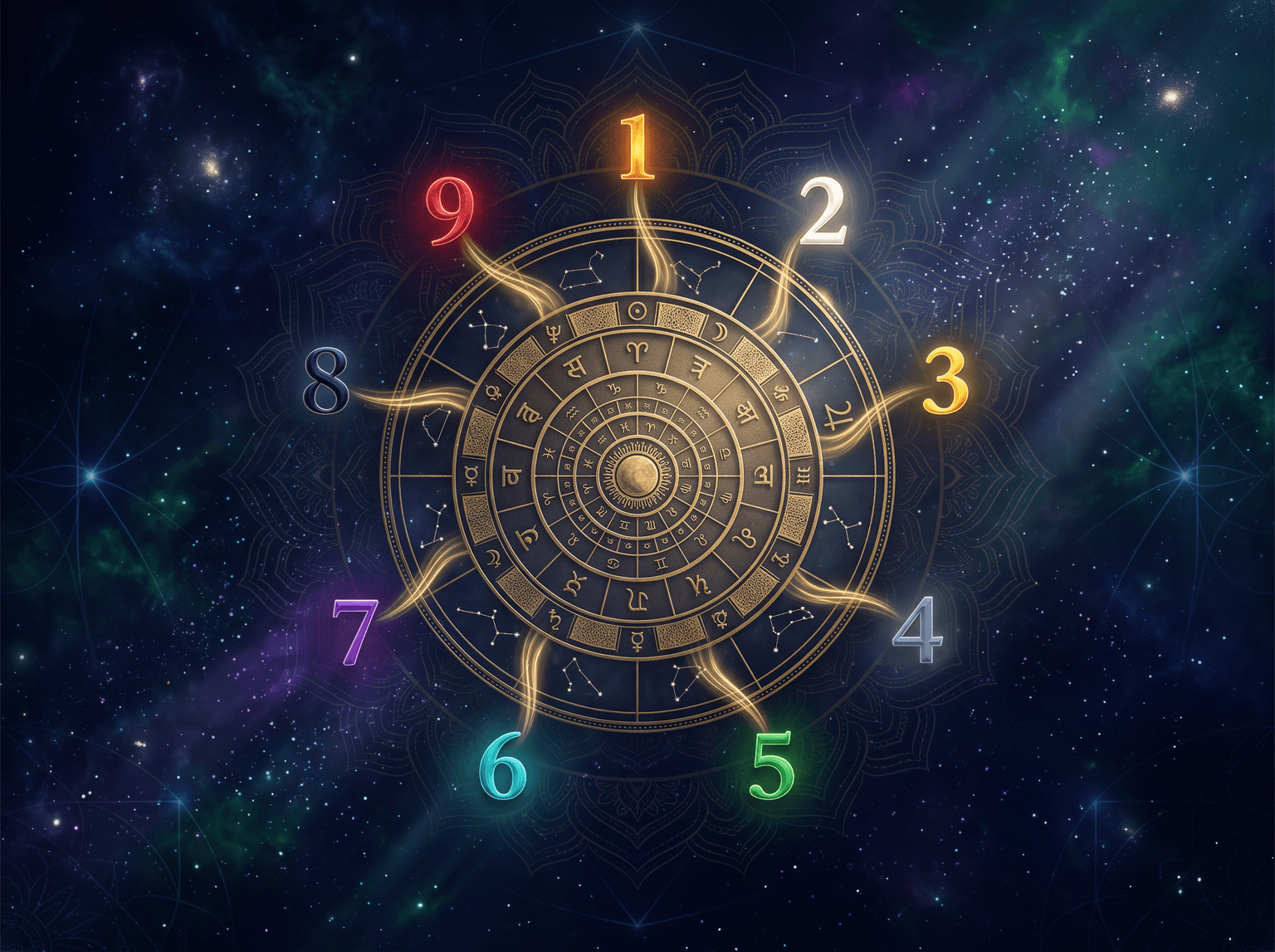
Numerology and astrology are often practiced separately, yet within Indian tradition they are closely related systems that can offer complementary insight. Your birth date carries numerical significance that works alongside, rather than in place of, your planetary chart.
What is Vedic Numerology?
Vedic numerology assigns each number from 1 to 9 a ruling planet, and calculates two primary numbers from a person's birth date: the Mulank, or root number, and the Bhagyank, or destiny number.
The Mulank is derived from the day of birth, while the Bhagyank is calculated by reducing the full birth date to a single digit.
How Numbers Connect to Planets
Number 1 is ruled by the Sun, 2 by the Moon, 3 by Jupiter, 4 by Rahu, 5 by Mercury, 6 by Venus, 7 by Ketu, 8 by Saturn, and 9 by Mars.
This means your Mulank and Bhagyank essentially highlight which planetary energies are most active in shaping your personality and life path.
Essential Key Insight
“How Mulank and Bhagyank interact with your planetary chart for a fuller life picture.”
Where Numerology and Astrology Overlap
When a person's Mulank number aligns with a strong planet in their birth chart, that planet's themes are often considered doubly emphasized in daily life.
Conversely, when the ruling planet of a number is weak or afflicted in the chart, numerologists often recommend supportive remedies similar to those used in planetary astrology.
Practical Uses of Numerology
Many people use numerology alongside astrology to choose auspicious dates, evaluate name compatibility, or select favorable numbers for important decisions such as vehicle registration or business names.
It is generally treated as a supportive, simplified system rather than a replacement for detailed chart analysis.
Final Thoughts
Numerology offers an accessible entry point into the deeper logic of Vedic astrology, since both systems trace back to the same nine planetary energies. Used together, they can offer a richer, more consistent picture of a person's path.